Today, lets talk about ways to help with your gas mileage. I suppose by now you have seen the price of a gallon of gas rise it seems like every day. There are many things you can do with your everyday driving and items on your vehicle to help you get better mileage. Let's keep more money in your pocket.
FIRST, let's look at driving more efficiently.
Drive Sensibly

Aggressive driving (speeding, rapid acceleration and braking) wastes gas. It can lower your gas mileage by 33 percent at highway speeds and by 5 percent around town. Sensible driving is also safer for you and others, so you may save more than gas money.
Observe the Speed Limit
 While each vehicle reaches its optimal fuel economy at a different speed (or range of speeds), gas mileage usually decreases rapidly at speeds above 60 mph.
 You can assume that each 5 mph you drive over 60 mph is like paying an additional $0.24 per gallon for gas.
Observing the speed limit is also safer.
Remove Excess Weight

Avoid keeping unnecessary items in your vehicle, especially heavy ones. An extra 100 pounds in your vehicle could reduce your MPG by up to 2 percent. The reduction is based on the percentage of extra weight relative to the vehicle's weight and affects smaller vehicles more than larger ones.
Avoid Excessive Idling

Idling gets 0 miles per gallon. Cars with larger engines typically waste more gas at idle than do cars with smaller engines.
Use Cruise Control
Using cruise control on the highway helps you maintain a constant speed and, in most cases, will save gas.Use Overdrive Gears
When you use overdrive gearing, your car's engine speed goes down. This saves gas and reduces engine wear.SECOND, let's keep your car in shape.
Keep Your Engine Properly Tuned
 Fixing a car that is noticeably out of tune or has failed an emissions test can improve its gas mileage by an average of 4 percent, though results vary based on the kind of repair and how well it is done.
Fixing a serious maintenance problem, such as a faulty oxygen sensor, can improve your mileage by as much as 40 percent.
Keep Tires Properly Inflated
 You can improve your gas mileage by up to 3.3 percent by keeping your tires inflated to the proper pressure. Under-inflated tires can lower gas mileage by 0.3 percent for every 1 psi drop in pressure of all four tires. Properly inflated tires are safer and last longer.
The proper tire pressure for your vehicle is usually found on a sticker in the driver's side door jamb or the glove box and in your owner's manual. Do not use the maximum pressure printed on the tire's sidewall.
Use the Recommended Grade of Motor Oil
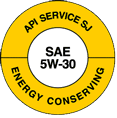
You can improve your gas mileage by 1–2 percent by using the manufacturer's recommended grade of motor oil. For example, using 10W-30 motor oil in an engine designed to use 5W-30 can lower your gas mileage by 1–2 percent. Using 5W-30 in an engine designed for 5W-20 can lower your gas mileage by 1–1.5 percent. Also, look for motor oil that says "Energy Conserving" on the API performance symbol to be sure it contains friction-reducing additives.
Replacing a Clogged Air Filter

Replacing a clogged air filter will help with the perfomance of the engine and can increase mileage from 2 to 6 % in older vehicles.
The certified technicians at Black Motor Co. can help you with all your vehicle needs. Call Donn for an appointment toll free 1-888-966-0572.

Commuting

Stagger your work hours to avoid peak rush hours.
Drive your most fuel-efficient vehicle.
Consider telecommuting (working from home) if your employer permits it.
Take advantage of carpools and ride-share programs. You can cut your weekly fuel costs in half and save wear on your car if you take turns driving with other commuters. Many urban areas allow vehicles with multiple passengers to use High Occupancy Vehicle (HOV) lanes which are typically less congested, further improving your fuel economy.
Consider using public transit if it is available and convenient for you. The American Public Transit Transportation Association has links to information about public transportation in your state.
Traveling

A roof rack or carrier provides additional cargo space and may allow you to meet your needs with a smaller car. However, a loaded roof rack can decrease your fuel economy by 5 percent. Reduce aerodynamic drag and improve your fuel economy by placing items inside the trunk whenever possible.
Avoid carrying unneeded items, especially heavy ones. An extra 100 lbs in the trunk reduces a typical car's fuel economy by 1-2 percent.

Thinking about buying a new vehicle?
You've come to the right place.www.fueleconomy.gov has gas mileage estimates and more information for 1984-2011 model year cars.
Selecting which vehicle to purchase is the most important fuel economy decision you'll make.
The difference between a car that gets 20 MPG and one that gets 30 MPG amounts to $768 per year (assuming 15,000 miles of driving annually and a fuel cost of $3.07).
That's $3,840 extra in fuel costs over five years!
Use www.fueleconomy.gov's Find and Compare Cars section to find the most fuel efficient vehicle that will meet your needs.
This information reprinted from the website http://www.fueleconomy.gov/
Black Motor has the help you need to increase your fuel mileage from vehicle repair and maintenence in our service and parts departments to a different vehicle either new or used to get that mileage you are looking for. Contact us at Black Motor Co. toll free 1-888-966-0572 for any and all your vehicle needs.
We want to wish both the Holdrege boys and girls basketball teams the best of luck at the State Tourney. You have put in the hard work and now you are reaping the fruits of that work. GOOD LUCK DUSTERS!!
I still have not lost hope in the Huskers to make the NCAA tourney after their win over Missou. Stay focused Huskers and we will back you all the way. We will have to talk about NASCAR on the blog in the near future and see how the Dodge Charger boys are doing.
Thanks
The BLACKMOTORWAY BLOGGER
.

No comments:
Post a Comment